Crate Hackers Review 2026: Is It Worth $30/Month?
What Crate Hackers actually does, who the curated crates help, where it falls short, and why crate-building works better on a clean Serato library.
Crate Hackers solves a different problem than its name suggests. It’s not an app for hacking apart a messy library, repairing a Serato database, or removing duplicate tracks. It’s a subscription for crate-building and music discovery — and judged as that, it has a real audience.
The product is curation: pre-made crates assembled by named DJs, refreshed regularly, and ordered so the tracks actually work in a set. Its desktop app can also scan your own library and build crates from music you already own. For a working DJ staring at an empty set plan on a Thursday, that’s useful. For a DJ staring at the same song six times in Serato search, it’s the wrong tool entirely. This review keeps those two jobs separate before getting to whether $30 a month is worth it.
What Crate Hackers actually is
Crate Hackers is a crate-building and music-discovery service. The curated crates cover genres, decades, and event types, with tracks arranged by BPM, key, and energy so a crate reads like a set, not an alphabetized folder.
The curation is human — named DJs build and refresh the crates — and that’s the core of what you’re paying for. Not another folder structure; someone else’s selection and prep work, delivered on a schedule.
The desktop app adds the personal angle: it scans your library and builds crates from tracks you already own, applying the same set-building logic to your own collection.
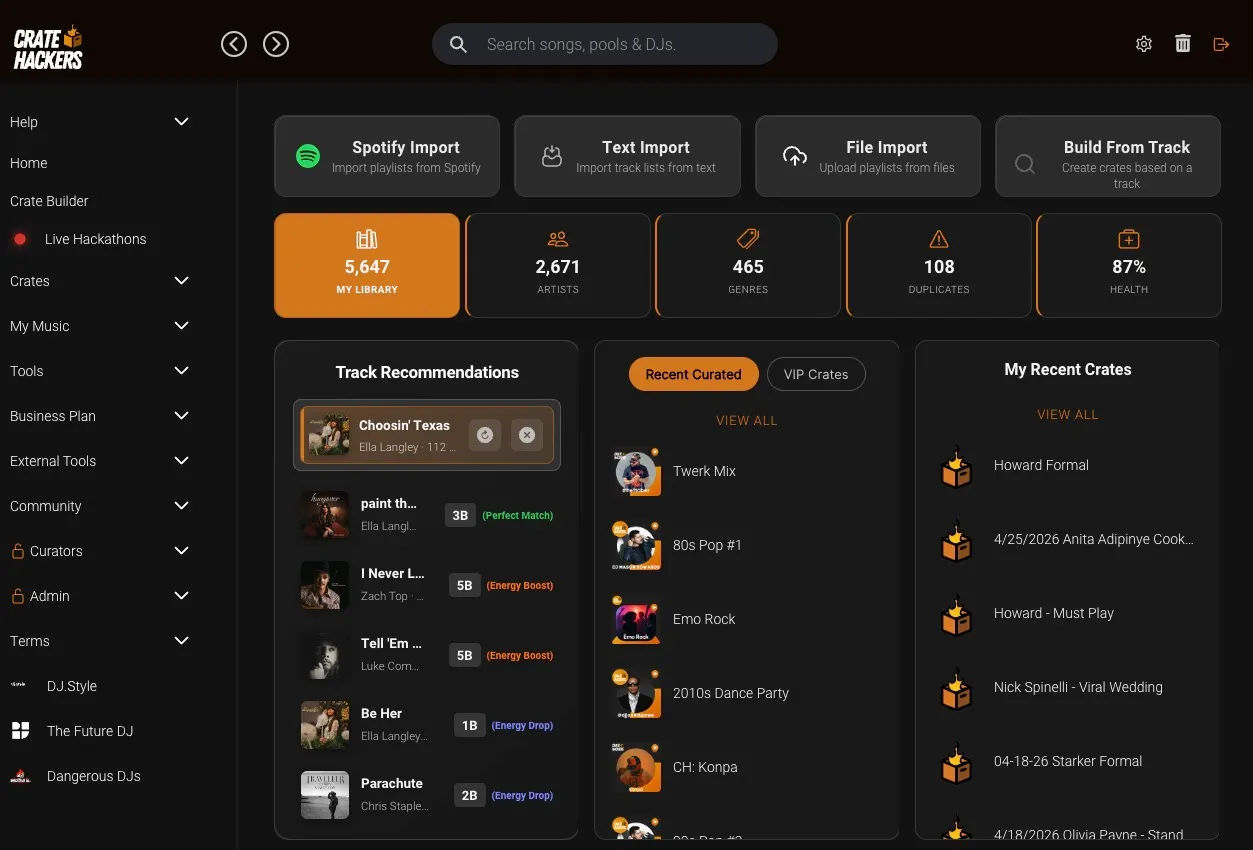
And the boundary, stated plainly: Crate Hackers doesn’t remove duplicates and doesn’t repair the Serato database. If your library problem is structural rather than creative, this isn’t the product for it.
How Crate Hackers works
You start from the pre-made crates instead of a blank screen — pick one shaped around a genre, decade, or event, and the BPM/key/energy ordering gives it a usable arc out of the box.
The regular refreshes are what make it a subscription rather than a one-time purchase of someone’s playlists. The service earns its fee when it’s part of your weekly prep, not when it’s opened once and forgotten.
The library scan ties it to what you own: rather than only browsing someone else’s picks, it can surface the right tracks from your existing files and assemble them into crates.
Where it’s strongest is the question “what do I play?” What it never touches is “which of these six copies should I delete?” or “why is this track orange?” Those are library-health questions, and curation doesn’t answer them.
How much does Crate Hackers cost?
$30 per month. Since it’s a subscription, the honest comparison isn’t the first month — it’s whether the crates and library scan keep helping your prep routine month after month.
Prepping fresh sets every weekend? The recurring cost can pay for itself in saved hours. Prep occasionally, or already have a crate system you trust? $30 a month buys curation you may not use enough to notice.
Who gets the most value?
Working open-format and wedding DJs are the clearest fit. Those gigs demand coverage across genres, decades, event moments, BPM ranges, and energy levels — and finding the right song fast is the job. Starting from a professionally structured selection instead of a blank crate is worth real money to that DJ.
It also fits DJs who own plenty of music but struggle to turn it into sets — a big collection isn’t a ready set, and the library scan helps bridge that gap. And some DJs simply rate another working DJ’s taste, which is a perfectly good reason to subscribe. Judging Crate Hackers for not cleaning databases would be unfair; cleanup was never its job.
The limitations
The first is just the math over time: at $30 a month, it needs to keep earning its spot. A service used weekly and a service opened twice a year cost the same.
The second is the one that matters for this site’s readers: the boundary between curation and library health. A curated crate is a view of the music underneath it. If the underneath is a mess — duplicate files, repeated Serato entries, broken paths — the crate layer inherits all of it. Scan a duplicate-riddled library into a crate-builder and you get well-organized crates with the same track appearing twice and search results you still can’t trust mid-set.
Crate Hackers has no duplicate removal and no Serato repair, so it can’t fix that layer — which isn’t a flaw, it’s a reason to do things in the right order: get the library healthy first, then let the curation layer sit on top of something solid. If library health is the immediate goal, start with the six-step Serato cleanup workflow.
Clean the library before building crates
The order matters because of how duplicates behave. The same song ends up in your library repeatedly for boring reasons — imported from two folders, pulled back off a gig USB, moved in Finder and re-added — and each path becomes its own Serato entry. (Why Serato duplicates keep reappearing breaks down the habits behind it.) Build crates on top of that and every duplicate is now clutter in two places: the library and the crate structure.
Cleaning first is a bounded job. Manually, it’s sorting by song name in Serato, comparing bitrates and paths, removing the loser entry, and separately deleting its file in Finder — the manual walkthrough covers the pitfalls. That works for a handful of pairs; for years of accumulation it’s an afternoon you won’t enjoy.
CrateSweep does that pass in minutes: it reads the Serato database directly, groups duplicates through Exact, Similar, and All Versions scans, and shows each copy’s play count and bitrate so you can judge what’s junk and what’s a legitimate alternate version. Smart Select pre-ticks the lower-value copies, everything stays overridable, and deletion removes the entry and moves the file to the Trash together — after a timestamped database backup. Scanning is free; deletion is $19 once. (Serato DJ v4+ on macOS Sonoma 14.0+ only — and to be clear, it builds zero crates. Different job.)
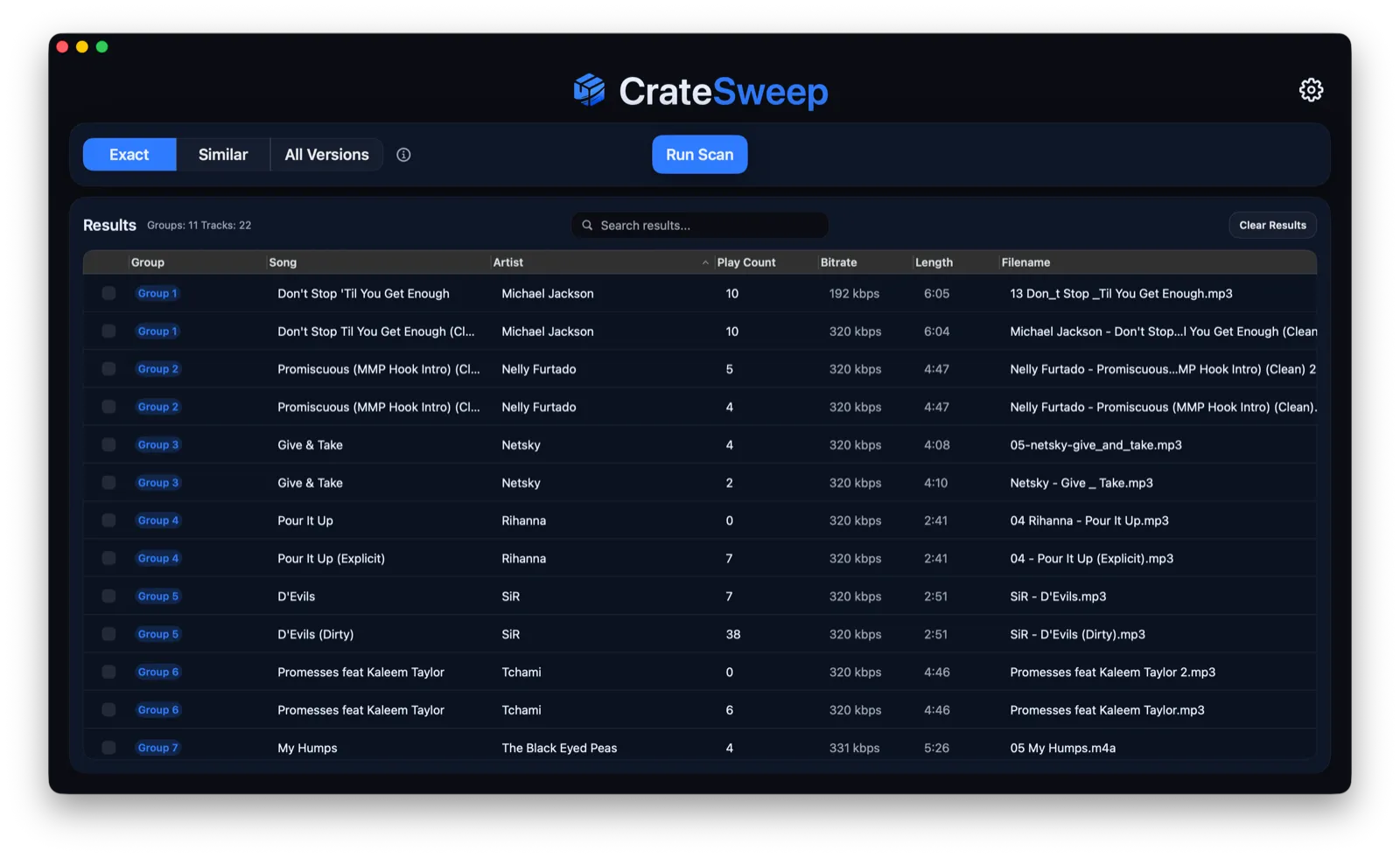
Then Crate Hackers gets to do what it’s actually good at, on a library where every track it surfaces is the one real copy.
Crate Hackers and CrateSweep are complements
These two aren’t competitors — one decides what belongs in the set, the other removes what shouldn’t be in the collection at all. The working order:
- Back up and repair the Serato library.
- Remove the duplicates; review alternate versions.
- Fix the import habits that created the repeats.
- Build or refresh crates from the clean collection.
That sequence keeps curation from becoming a nice-looking layer over unresolved mess.
(If what you actually want is a broader library manager — sync and conversion across DJ apps — that’s a third category again; the Lexicon DJ review covers it.)
Is Crate Hackers worth it?
Worth it: working open-format and wedding DJs who need mixable, event-ready selections every week, and anyone whose prep time is genuinely worth more than $30 a month. The curation is real, human, and regularly refreshed.
Harder to justify: DJs who rarely need new crates, already have a prep system, or — importantly — are shopping because their library is a mess. The subscription doesn’t remove duplicates or repair Serato, so don’t buy it expecting either.
Treat it as what it is: a crate-building service, measured by the selection help it gives you. Clean the library separately, and in that order — clean first, then build.
CrateSweep for Serato
Sweep your library in minutes
Find duplicate tracks, review every match, and keep your Serato crates clean before your next set.
Download Free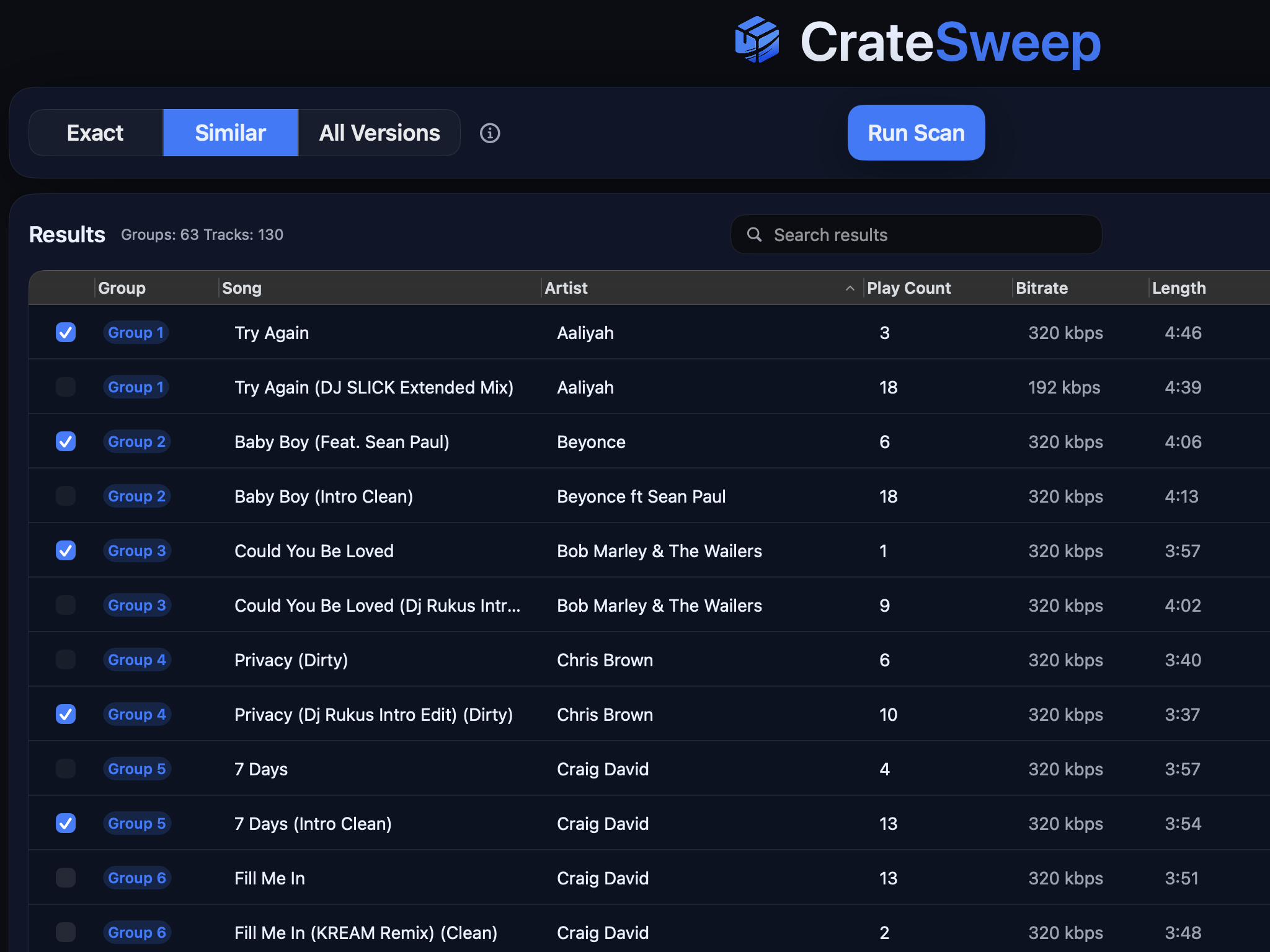
Related guides
dupeGuru vs CrateSweep for Serato Duplicates (2026)
dupeGuru is free but doesn't know Serato exists. What each tool catches, what deleting files does to your crates, and which is safer for DJs.
Lexicon vs CrateSweep for Cleaning a Serato Library
Lexicon and CrateSweep both find duplicate tracks, but they're built for different jobs. Pricing, workflow, and which to use for Serato cleanup.
Lexicon DJ Review 2026: Features, Pricing, Alternatives
An honest Lexicon DJ review for 2026: what the library manager does well, what it costs, and when a focused Serato cleanup tool is the better fit.